 |
 |
| Qin Dynasty | Han Dynasty |
 |
 |
| Three Kingdoms |
Jin dynasty(western & eastern jin) |
 |
 |
| Tang Dynasty |
Song Dynasty |
 |
 |
| Yuan Dynasty |
Ming Dynasty |
 |
|
| Qing Dynasty |
Showing posts with label Qing Dynasty. Show all posts
Showing posts with label Qing Dynasty. Show all posts
Friday, March 18, 2011
Maps of China by each dynasty


On Leibniz and the I Ching
Gottfried Wilhelm Leibniz (1646-1716), perhaps best known as the coinvenematics, philosophy, history, and numerous other fields, have led some to label him as a “universal genius.”
1 His accomplishments are even more astounding when one considers that he achieved most of his mathematical and philosophical breakthroughs in his spare time, as he was legal counselor by profession. But one particularly curious fact about this man is that he was perhaps one of the first European sinophiles (lovers of Chinese culture). For whatever reason, however, his interest in all things Chinese, was barely touched upon by many of his biographers and even those who specifically documented his philosophical influences.
2 In fact many people are quite surprised to hear that Leibniz expressed interests in the orient, so it is only natural to ask why Leibniz was so interested in China.
In particular, Leibniz was interested in the Chinese system of writing, which being an ideographic system, is quite different from the phonetic Roman alphabet used in the English, German, French, etc. Furthermore, Leibniz was particularly interested in a series of hexagrams found in the I Ching or Yi Jing (c. 1150 bce) which expressed numbers in what appeared to be binary form.
3 Leibniz, who was developing his own system of binary numbers at the time, was particularly fascinated that the Chinese supposedly had developed a concept of these numbers thousands of years earlier. This paper will investigate, albeit in breif, Leibniz’ interests in the Chinese, and in particular the nature of this ancient binary system found in the I Ching hexagrams.
Many European thinkers during the 17th and 18th centuries expressed an uncanny enthusiasm for any information concerning the culture and practices of the Americas, Africa, Persia, India, and China. Western merchants, diplomats, missionaries, and travelers were often asked for accounts of their travelers, and these accounts, whether true or false, were often exciting to Westerners, who were in want of something to exercise their imaginations with.
4 However, as tempting as it may be to write off the interests of a polymath as nothing more than a general romanticized curiosity shared by his contemporaries, Leibniz’ interests in Chinese culture, can be explained by a more careful examination of his philosophical ideas and areas of interests. After hearing
of a theory expounded by the Dutch orientalist, Jacob Gohl, which postulated that the Chinese language had been created to establish verbal communication between a large number of diverse nations, Leibniz sought to investigate whether or not the Chinese written language could be employed as a universal language. Leibniz desired a system of communication which would allow philosophers from around the world to communicate abstract ideas with precision and accuracy, without the interference of cultural and linguist differences; an ideographic system of writing seemed most likely to suit such needs. As it turns out, Leibniz was not satisfied with the Chinese system of writing for this purpose, as he found that Chinese characters were “apparently content in [giving] several connotations.” Nevertheless, this was not a setback which deterred Leibniz from further investigating elements of Chinese culture, especially as he was beginning to appreciate Confucianphilosophy, and interpreting ancient Chinese beliefs which are now seen as agnostic as
monotheistic.
5 More recent scholarship on Leibniz, however, also suggest that Leibniz may have had one of several, although not necessarily mutually exclusive reasons, for his interest in Chinese culture. Even though he was often classified
as a rationalist, Leibniz may have had more practical motivations. Moreover, perhaps Leibniz’ investigations
of logic were motivated by practical and theological concerns with the cultural exchange of information. Lastly, some scholars point to the likely possibility that Leibniz was a pluralistic thinker, wanting to bring different schools of thoughts and cultural ideas together.
6 Finally, it should be added that Leibniz’ ideas and conceptions
of China were formed by a 17th century European view of China, even if the most optimistic and enthusiastic one possible. Indeed, all of Leibniz’ understanding of China came from a small group of Jesuit missionaries in China which he was in continual communication with, and also a few Chinese texts, translated by Jesuits.
Whatever the case may have been, Leibniz’ sinophilia certainly stems from a variety of factors, not the least of which were his particular philosophical motivations.
One revelation about the Chinese which particularly caught Leibniz’ attention came in 1700 when the Jesuit Joachim Bouvet brought ancient Chinese diagrams depicting what appeared to be some vital lost philosophy to the attention of Leibniz; these were the I Ching hexagrams which included solid and broken lines with progressed in a sequence that was unmistakably binary. In fact, Leibniz had been developing such a system after he expressed a keen interest in non-decimal number bases some time earlier.
7 The immediate appeal of this system to Leibniz was not out of pure mathematical interest alone, indeed the diagrams only served to reaffirm for Leibniz that a system of “ones” and “zeros” capable of expressing any possible value only served to show how God could create the universe from “unity” and “nothingness.” Furthermore, Leibniz, already well versed in sinology, understood that the symbols represented the duality between yin and yang, proving (to Leibniz) that the ancient Chinese had a similar notion of God and a universal number system. Above all, it appears that Leibniz had something of an agenda, when it came to trying to fit the sum of all of human inquiry across all cultures into his own metaphysical world view.
8 However, the question remains as to whether the ancient Chinese really understood the progression of binary numbers, and if so, did they understand how to carry arithmetic or logical operations on such numbers? There can be little doubt that they, at the very least, understood that these symbols followed a clear pattern, but whether or not they ever made the connection between such an organized progression of symbols and their use in expressing quantities in the same fashion of conventional numbers remains an open question. In any case, Leibniz had indeed conjectured further that the ancient Chinese had understood binary arithmetic, and perhaps even had a concept of applying binary arithmetic to the proving of logical propositions (a concept akin to modern Boolean algebra). Although some researchers claim that the Chinese did possess a deep understanding of logical formalism, the majority
of contemporary scholarship feels that Leibniz overestimated Chinese knowledge regarding formal logic and binary arithmetic.
9 Still many scholars are unsatisfied with the lack of certainty regarding ancient Chinese understanding of the binary number system, but lack of any other evidence of their use of binary numbers (the I Ching is an isolated case), seems to imply that they didn’t understand the significance of these numbers
in the same sense that Leibniz did. Whatever the case may have been regarding the veracity of Leibniz’ presumptions regarding the extent of ancient Chinese knowledge, this episode only serves as a further example of why Leibniz was so interested in the Chinese: he perceived the philosophical ideas of the Chinese as being in line with his own metaphysical world view.
As it turns out, Leibniz was probably wrong in regards to the Chinese, but he could not have been more right in regards to understanding that the duality of “ones” and “zeros” was a vital step in expressing logical formalism, and in his search, Leibniz practically laid out the path for the coming digital age and modern computing as we know it today. Perhaps Leibniz would consider our computers as being a step closer to the universal language he sought throughout his life. After all, this paper was created using “ones” and “zeros.”
1 His accomplishments are even more astounding when one considers that he achieved most of his mathematical and philosophical breakthroughs in his spare time, as he was legal counselor by profession. But one particularly curious fact about this man is that he was perhaps one of the first European sinophiles (lovers of Chinese culture). For whatever reason, however, his interest in all things Chinese, was barely touched upon by many of his biographers and even those who specifically documented his philosophical influences.
2 In fact many people are quite surprised to hear that Leibniz expressed interests in the orient, so it is only natural to ask why Leibniz was so interested in China.
In particular, Leibniz was interested in the Chinese system of writing, which being an ideographic system, is quite different from the phonetic Roman alphabet used in the English, German, French, etc. Furthermore, Leibniz was particularly interested in a series of hexagrams found in the I Ching or Yi Jing (c. 1150 bce) which expressed numbers in what appeared to be binary form.
3 Leibniz, who was developing his own system of binary numbers at the time, was particularly fascinated that the Chinese supposedly had developed a concept of these numbers thousands of years earlier. This paper will investigate, albeit in breif, Leibniz’ interests in the Chinese, and in particular the nature of this ancient binary system found in the I Ching hexagrams.
Many European thinkers during the 17th and 18th centuries expressed an uncanny enthusiasm for any information concerning the culture and practices of the Americas, Africa, Persia, India, and China. Western merchants, diplomats, missionaries, and travelers were often asked for accounts of their travelers, and these accounts, whether true or false, were often exciting to Westerners, who were in want of something to exercise their imaginations with.
4 However, as tempting as it may be to write off the interests of a polymath as nothing more than a general romanticized curiosity shared by his contemporaries, Leibniz’ interests in Chinese culture, can be explained by a more careful examination of his philosophical ideas and areas of interests. After hearing
of a theory expounded by the Dutch orientalist, Jacob Gohl, which postulated that the Chinese language had been created to establish verbal communication between a large number of diverse nations, Leibniz sought to investigate whether or not the Chinese written language could be employed as a universal language. Leibniz desired a system of communication which would allow philosophers from around the world to communicate abstract ideas with precision and accuracy, without the interference of cultural and linguist differences; an ideographic system of writing seemed most likely to suit such needs. As it turns out, Leibniz was not satisfied with the Chinese system of writing for this purpose, as he found that Chinese characters were “apparently content in [giving] several connotations.” Nevertheless, this was not a setback which deterred Leibniz from further investigating elements of Chinese culture, especially as he was beginning to appreciate Confucianphilosophy, and interpreting ancient Chinese beliefs which are now seen as agnostic as
monotheistic.
5 More recent scholarship on Leibniz, however, also suggest that Leibniz may have had one of several, although not necessarily mutually exclusive reasons, for his interest in Chinese culture. Even though he was often classified
as a rationalist, Leibniz may have had more practical motivations. Moreover, perhaps Leibniz’ investigations
of logic were motivated by practical and theological concerns with the cultural exchange of information. Lastly, some scholars point to the likely possibility that Leibniz was a pluralistic thinker, wanting to bring different schools of thoughts and cultural ideas together.
6 Finally, it should be added that Leibniz’ ideas and conceptions
of China were formed by a 17th century European view of China, even if the most optimistic and enthusiastic one possible. Indeed, all of Leibniz’ understanding of China came from a small group of Jesuit missionaries in China which he was in continual communication with, and also a few Chinese texts, translated by Jesuits.
Whatever the case may have been, Leibniz’ sinophilia certainly stems from a variety of factors, not the least of which were his particular philosophical motivations.
One revelation about the Chinese which particularly caught Leibniz’ attention came in 1700 when the Jesuit Joachim Bouvet brought ancient Chinese diagrams depicting what appeared to be some vital lost philosophy to the attention of Leibniz; these were the I Ching hexagrams which included solid and broken lines with progressed in a sequence that was unmistakably binary. In fact, Leibniz had been developing such a system after he expressed a keen interest in non-decimal number bases some time earlier.
7 The immediate appeal of this system to Leibniz was not out of pure mathematical interest alone, indeed the diagrams only served to reaffirm for Leibniz that a system of “ones” and “zeros” capable of expressing any possible value only served to show how God could create the universe from “unity” and “nothingness.” Furthermore, Leibniz, already well versed in sinology, understood that the symbols represented the duality between yin and yang, proving (to Leibniz) that the ancient Chinese had a similar notion of God and a universal number system. Above all, it appears that Leibniz had something of an agenda, when it came to trying to fit the sum of all of human inquiry across all cultures into his own metaphysical world view.
8 However, the question remains as to whether the ancient Chinese really understood the progression of binary numbers, and if so, did they understand how to carry arithmetic or logical operations on such numbers? There can be little doubt that they, at the very least, understood that these symbols followed a clear pattern, but whether or not they ever made the connection between such an organized progression of symbols and their use in expressing quantities in the same fashion of conventional numbers remains an open question. In any case, Leibniz had indeed conjectured further that the ancient Chinese had understood binary arithmetic, and perhaps even had a concept of applying binary arithmetic to the proving of logical propositions (a concept akin to modern Boolean algebra). Although some researchers claim that the Chinese did possess a deep understanding of logical formalism, the majority
of contemporary scholarship feels that Leibniz overestimated Chinese knowledge regarding formal logic and binary arithmetic.
9 Still many scholars are unsatisfied with the lack of certainty regarding ancient Chinese understanding of the binary number system, but lack of any other evidence of their use of binary numbers (the I Ching is an isolated case), seems to imply that they didn’t understand the significance of these numbers
in the same sense that Leibniz did. Whatever the case may have been regarding the veracity of Leibniz’ presumptions regarding the extent of ancient Chinese knowledge, this episode only serves as a further example of why Leibniz was so interested in the Chinese: he perceived the philosophical ideas of the Chinese as being in line with his own metaphysical world view.
As it turns out, Leibniz was probably wrong in regards to the Chinese, but he could not have been more right in regards to understanding that the duality of “ones” and “zeros” was a vital step in expressing logical formalism, and in his search, Leibniz practically laid out the path for the coming digital age and modern computing as we know it today. Perhaps Leibniz would consider our computers as being a step closer to the universal language he sought throughout his life. After all, this paper was created using “ones” and “zeros.”
 |
 |
| Joachim Bouvet( 1656-1730 ) | I Ching Hexagram |
 |
 |
| HeTu (ancient chinese mysterious pattern) | LuoShu (ancient chinese mysterious pattern) |
Emperor Guangxu
 Born in August 14th in 1871, Emperor Guangxu was named Aixinjueluo Zaitian, whose father was the seventh son of Emperor Daoguang. In 1874, Emperor Tongzhi died of an illness. Since he had no heir to take over the throne, the powerful and tactful Empress Dowager Cixi chose Zaitian (whose mother was a sister of Cixi), so that she could still keep her domination over the imperial power. In 1887, Emperor Guangxu held the inauguration ceremony. However, the real power was still grasped by Cixi who continued to hold court from behind a screen for another two years. Seeing from Emperor Guangxu's accession to the throne, he was bound to be manipulated by his 'foster mother' Cixi.
During the reign of Emperor Guangxu, the most two remarkable events were the Sino-Japanese War and the Wu Hsu Reform in 1898. In dealing with the Sino-Japanese War, Emperor Guangxu strongly objected to compromise and for many times forced the Qing army to fight against the Japanese army. Nevertheless, Emperor Guangxu was overpowered by the weak corrupt Qing court and the Qing court underwent a fiasco in the Sino-Japanese War. After learning the painful lessons, Emperor Guangxu began to think over the renovation to adjust the court order and prevent the entire state from declining. In 1898, along with a group of reform advocators, he promulgated the prescript called Ding Guo Shi Zhao to commence the renovation. Unfortunately, lasting for only 103 days, the vigorous reform movement was killed by the opposite parties who launched a coup against all reform parties. After that, Emperor Guangxu again lost his imperial power to the hands of Cixi and he was later house arrested by Cixi.
In 1900, the so-called Eight-Power Allied Forces invaded China. Confronting the fatal crisis, Emperor Guangxu ever decided to stay in the capital to stabilize the public mind but he was taken to Xian by Empress Dowager Cixi before the fall of Beijing. The next year when they came back from Xian, Emperor Guangxu was still kept away from the state affairs. Till 1908, Emperor Guangxu died in depression and gloom was buried in the West Qing Tombs.
All in all, although Emperor Guangxu's political life was full of tragic elements, he was regarded as progressive monarch. Being a pioneer of the capitalist renovation, his deeds broke the thought retention of the feudal autocracy and started the ideological liberation of China. Therefore, Emperor Guangxu has been creditably remembered as an enlightened emperor who first tried to adopt the western political pattern to govern China.
Empress Dowager Cixi
 Usually, when we refer to the Empress Dowager Cixi, we tend to compare her with the great empress Wu Zetian of the Tang Dynasty (618 - 907). Admittedly, these two powerful women indeed had much in common: they both assisted three successive emperors being their husbands and sons and they both held real imperial power for nearly half a century. However, what was different between the two was that Wu Zetian ascended to the throne herself and her reign was considered as an indispensable connection between Li Shimin's Zhenguan Reign and Li Longji's Heyday of Kaiyuan; whereas Cixi's ruling period was regarded as the weakest period of the Qing Dynasty. Hence, Empress Dowager Cixi has always been remembered as a notorious lady who even betrayed her country.
Here is a chronology of Cixi's life:
On November 28th of 1835, Cixi was born, surnamed Yehe Nala.
In 1851, she was selected as a beauty into the palace. Due to the favor of Emperor Xianfeng, she was honored as a high-ranked imperial concubine, with the title of Yipin.
In 1854, she was given a higher rank, with the title changed to Yi Guifei.
In 1856, she gave birth to Zaichun who later became Emperor Tongzhi.
In 1861, the Second Opium War broke out. After Emperor Xianfeng died in August, Cixi's son ascended the throne as Emperor Tongzhi, who honored his mother as 'Holy Mother Empress Dowager'. In November, along with Prince Gong (brother-in-law of Cixi), Cixi launched a coup in which the eight chancellors were dismissed or killed. As a result, Cixi became the real power by keeping court from behind a screen.
In 1862, she was given the title of Empress Dowager Cixi by Emperor Tongzhi (Actually, she gave the title to herself through Emperor Tongzhi's prescript).
In 1873, as Emperor Tongzhi had grown up, Cixi appeared to turn the power over to him but she still held power behind the scenes.
In 1874, Emperor Tongzhi died. Cixi chose another grandson of Emperor Daoguang as the heir - Emperor Guangxu. Because she was aunt of Emperor Guangxu, she could continue ruling from behind the screen.
In 1889, Emperor Guangxu married. Cixi announced that she would relinquish her power and retire to live in the Summer Palace. However, all the court officials still listened to her, leaving Emperor Guangxu as a puppet emperor.
In 1894, Japan launched the Sino-Japanese War while Cixi was busy preparing the celebration of her 60th birthday. What's worse, when the Chinese navy fought fiercely with the Japanese, Cixi strongly insisted on appropriating the military fund to restore the Summer Palace, ignoring the advice of chancellors.
In 1895, the Qing Navy was defeated due to the compromise of Cixi. Taiwan Island ceded.
In 1898, Cixi launched a coup against Emperor Guangxu's Wu Hsu Reform. After that, she executed the main reform party members and from then on she put Emperor Guangxu under house arrest.
In 1900, the Eight-Power Allied Forces captured capital Beijing. Cixi took Emperor Guangxu with her and fled to Xian. In September, another humiliating treaty - Peace Treaty of 1901 was signed.
On November 15th of 1908, the day after the death of Emperor Guangxu, Empress Dowager Cixi died in the afternoon.
Qing Dynasty
 |
| Forbidden City, Beijing |
In 1636, Huang Taiji, son of Nurhachu moved the capital to Shenyang (currently the capital city of Liaoning Province) and changed the regime title into 'Qing'. He thus established the Qing Dynasty. In 1644 when peasant's uprising leader Li Zicheng ended the Ming Dynasty and set up a new regime in Beijing, the Qing army seduced a general named Wu Sangui to rebel against Li Zicheng. With Wu's help, the Qing army successfully captured Beijing and rooted their regime there.
At the beginning, the Qing court carried out a series of policies to revive the social economy and alleviate the class contradiction. In politics, following the ruling pattern of the Ming Dynasty, the imperial rulers continued to strengthen the centralized system. Meanwhile, the Qing court resumed the 'Sheng' administrative system that originated in the Yuan Dynasty (1271 - 1368). Especially, in the frontiers like Tibet, Xinjiang, Mongol and Taiwan Island, the Qing court set out to enhance the power of the imperial ruling.
By the middle of the 18th century, the feudal economy of the Qing Dynasty reached a zenith, spanning the reign of Emperor Kangxi, Emperor Yongzheng and Emperor Qianlong. So that period was usually called 'the golden age of three emperors'. In that period, both culture and science were much more prosperous than any other periods of the Qing Dynasty. The notable book, The Imperial Collection of Four, was edited in that period. Also, a group of scholars and artists such as Cao Xueqin (writer of A Dream of Red Mansions), Wu Jingzi (writer of The Scholars) and Kong Shangren (writer of The Peach Blossom Fan) gradually appeared. In the field of science, the achievements in architecture were outstanding.
After the middle period, all kinds of social contradictions increasingly surfaced and the Qing Dynasty began to decline. Under the corrupt ruling of the later rulers, various rebellions and uprisings broke out. In 1840 when the Opium War broke out, the Qing court was faced with troubles at home and aggression from abroad. During that period, measures were adopted by imperial rulers and some radical peasants to bolster their power. The Westernization Movement, the Reform Movement of 1898 and the Taiping Rebellion were the most influential ones, but none of them had ever succeeded in saving the dying Qing Dynasty.
Finally, the Revolution of 1911 led by Sun Yat-sen broke out and overthrew the Qing Dynasty, bringing two thousand years of Chinese feudal monarchy to an end.
Emperors of the Qing Dynasty
 |
| Old Summer Palace was destroyed by British and French troop in 1860 |
By the middle of the 18th century, the feudal economy of the Qing Dynasty reached a zenith, spanning the reign of Emperor Kangxi, Emperor Yongzheng and Emperor Qianlong. So that period was usually called 'the golden age of three emperors'. In that period, both culture and science were much more prosperous than any other periods of the Qing Dynasty. The notable book, The Imperial Collection of Four, was edited in that period. Also, a group of scholars and artists such as Cao Xueqin (writer of A Dream of Red Mansions), Wu Jingzi (writer of The Scholars) and Kong Shangren (writer of The Peach Blossom Fan) gradually appeared. In the field of science, the achievements in architecture were outstanding.
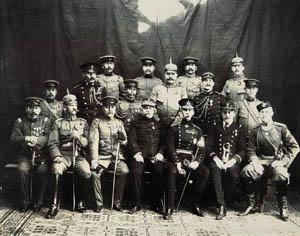 |
| Eight-Nation Allied Forces |
Finally, the Revolution of 1911 led by Sun Yat-sen broke out and overthrew the Qing Dynasty, bringing two thousand years of Chinese feudal monarchy to an end.
Emperors of the Qing Dynasty
| Order |
Name
|
Notes
|
Reign Time (years) |
| 1 | Emperor Taizu (Nurhachu) |
Founder of the Latter Jin regime which later turned into the Qing regime; He created the military organization called Banner System. | 1616 - 1626 |
| 2 | Emperor Taizong (Huang Taiji) |
The eighth son of Nurhachu; actually the first emperor of the Qing Dynasty. He moved the capital to Shenyang. | 1626 - 1643 |
| 3 | Emperor Shunzhi (Fulin) |
Son of Huang Taiji; In his reign, the Qing army defeated the Ming Dynasty (1368 - 1644) and moved the capital into Beijing. | 1643 - 1661 |
| 4 | Emperor Kangxi (Xuanye) |
The third son of Emperor Shunzhi; One of the greatest emperors in the Qing Dynasty; His reign was the beginning of the heyday of the Qing Dynasty. | 1661 - 1722 |
| 5 | Emperor Yongzheng (Yinzhen) |
The fourth son of Emperor Kangxi; A fairly wise and competent emperor who maintained the prosperity of the Qing Dynasty | 1722 - 1735 |
| 6 | Emperor Qianlong (Hongli) |
Son of Emperor Yongzheng; Inheriting the prosperity brought by his predecessors, his reign reached the zenith of the Qing Dynasty. | 1735 - 1796 |
| 7 | Emperor Jiaqing (Yongyun) |
Son of Emperor Qianlong; He prosecuted the infamous corrupt official, He Shen, who used to be a favorite chancellor of Emperor Qianlong. | 1796 - 1820 |
| 8 | Emperor Daoguang (Minning) |
Son of Emperor Jiaqing; His reign saw the outbreak of the First Opium War in 1840, from which China entered the modern history. | 1820 - 1850 |
| 9 | Emperor Xianfeng (Yizhu) |
Son of Emperor Daoguang; In his reign, the Qing Dynasty apparently began to decline. The well-known Taiping Rebellion broke out in that period. | 1850 - 1861 |
| 10 | Emperor Tongzhi (Zaichun) |
Son of Emperor Xianfeng and Empress Dowager Cixi; died early | 1861 - 1875 |
| 11 | Emperor Guangxu (Zaitian) |
Grandson of Emperor Daoguang; a progressive emperor who tried lots of methods to save the declining Qing Dynasty | 1875 - 1908 |
| 12 | Emperor Xuantong (Puyi) |
The last emperor of the Qing Dynasty and the last feudal monarch of China; He was imprisoned at Shenyang till 1959 when Chairman Mao remitted him. | 1908 - 1911 |
Subscribe to:
Posts (Atom)